Monday, July 06, 2015

At Play In The Semiosphere


I will be discussing Patrick Dunn's approach to reality handling and manipulation within the context of Cinemorphic self shifting in future posts. Interesting parallels and implications...

“Think of a huge web stretching across the black emptiness of space. In each nexus of lines rests a symbol connecting to an infinite number of other symbols. It is important to grasp this concept, because symbols are the underlying girders of the universe.

I call this complex of recursive symbols ‘the semiotic web.’ When seeking meaning, the mind says ‘I can place any idea in my semiotic web, which I've built up from all the symbols of our culture, and have it make sense to me.’

I believe the semiotic web is the substance of ultimate reality. More than just an abstraction to explain the way the human mind works, I think it is the abstraction to explain how Mind works. Mind is not separate from reality, nor is reality separate from the semiotic spaces it inhabits.


Manipulating symbol systems manipulates the semiotic web, and therefore manipulates reality.”

Patrick Dunn. Postmodern Magic: The Art of Magic in the Information Age http://www.amazon.com/Postmodern-Magic-The-Art-Information/dp/0738706639


Friday, May 22, 2015

How Artificial Superintelligence Will Give Birth To Itself


"How Artificial Superintelligence Will Give Birth To Itself" by George Dvorsky is a particularly interesting window on the world of AI research from the POV of Cinemorphics...

"There's a saying among futurists that a human-equivalent artificial intelligence will be our last invention. After that, AIs will be capable of designing virtually anything on their own — including themselves. Here's how a recursively self-improving AI could transform itself into a superintelligent machine." 

For the entire article click HERE.

Ex Machina, AI and Cinemorphics


Ex Machina's AI, Ava, seems to have developed, after her original inception, a very interesting form of intelligence...the ability to choose and "absorb" new abilities for herself. An interesting analysis of the film may be found HERE...

/

Also...COMING SOON...Cinemorphics as an AI protocol...enabling persona creation in robots!

Tuesday, May 12, 2015

American Eyeball

(American Eyeball is actually a film about Cinemorphics and Imaginal Realism posing as a noirish San Francisco detective story. The same can be said of the novella Satori Tango.)


A new Benny Pristine mystery! The notorious San Francisco detective reappears after a twenty year disappearance to find his best friend murdered, a psychic spy still wanting to take him to bed, the fate of the world threatened by incompetent aliens and more!


American Eyeball - Trailer from Charles Webb on Vimeo.

Read the Benny Pristine novella SATORI TANGO!

Sunday, February 08, 2015

Ruby Wax on Neuroplasticity: "You're the Architect of Your Own Brain"


Ruby Wax put her comedy career on hold a few years ago in order to research mental illness and mindfulness-based cognitive therapy at Oxford. It's there that she first encountered neuroplasticity: the ability to rewire your brain just by changing the way you think. Wax, who sports a Master's in Mindfulness-based Cognitive Behavioural Therapy, now travels the world promoting mental health awareness and stigmatization. Her new book is titled "Sane New World."   
To play video please visit: http://bigthink.com/videos/ruby-wax-on-neuroplasticity

Friday, January 30, 2015

Sunday, January 11, 2015

Should Schools Teach Personality!


Self-control, curiosity, “grit” — these qualities may seem more personal than academic, but at some schools, they’re now part of the regular curriculum. Some researchers say personality could be even more important than intelligence when it comes to students’ success in school. But critics worry that the increasing focus on qualities like grit will distract policy makers from problems with schools.


For the entire article click HERE .

Sunday, December 28, 2014

Me, Myself and Us


(Brian R. Little)...begins by addressing “personal constructs” — what he calls “the cognitive goggles you use to understand yourself and others.” There are “core” constructs, he explains, closely tied to one’s sense of self, and “peripheral” constructs, more loosely attached to one’s identity. “To the extent that you have an overly dominant core construct along which much of your construing is organized, you have limited degrees of freedom in navigating your world,” Little notes. “If, however, you have many independent personal constructs or several pairs of goggles through which to anticipate events, when one pair doesn’t work so well or is invalidated, you can switch to a different construct.” Add single-goggle and multi-­goggle to his growing list of types.


For the entire article please click HERE.

Wednesday, December 17, 2014

Committee for Surrealist Investigation of Claims of the Normal - The Birth of Patapsychology


...Patapsychology begins from Murphy's Law, as Finnegan called the First Axiom, adopted from Sean Murphy. This says,and I quote,"The normal does not exist. The average does not exist. We know only a very large but probably finite phalanx of discrete space-time events encountered and endured." In less technical language, the Board of the College of Patapsychology offers one million Irish punds [around $700,000 American] to any "normalist" who can exhibit "a normal sunset, an average Beethoven sonata, an ordinary Playmate of the Month, or any thing or event in space-time that qualifies as normal, average or ordinary."...(cont.)

For the entire piece about the genesis of patapsychology, click HERE.

Saturday, December 13, 2014

Is Consciousness A Product Of The Brain Or Is The Brain The Receiver Of Consciousness?


“I regard consciousness as fundamental. I regard matter as derivative from consciousness. We cannot get behind consciousness. Everything that we talk about, everything that we regard as existing, postulates consciousness.” – Max Planck, theoretical physicist who originated quantum theory, which won him the Nobel Prize in Physics in 1918
It’s great to see that in today’s day and age, multiple prominent scientists from all over the world have started to study and examine several different areas that deal with non-physical phenomenon and human consciousness. Truth is they’ve been doing it for decades, but it’s just now starting to receive the recognition it deserves.
For the rest of the article please click HERE .

Sunday, November 23, 2014

Twine, the Video-Game Technology for All

Perhaps the most surprising thing about “GamerGate,” the culture war that continues to rage within the world of video games, is the game that touched it off. Depression Quest, created by the developers Zoe Quinn, Patrick Lindsey and Isaac Schankler, isn’t what most people think of as a video game at all...

To read the entire article please click HERE. 

Sunday, November 16, 2014

play/search - A Quest


This Alternate Reality Game/Quest is offered as an amusing challenge to all (science/art) players of good will...a new game is afoot...let's see where it leads...


A Quest…(a treasure hunt)... Find the best source(s) of funding for an initial play/search project entitled...
(Please read the link material and watch the videos before embarking on the quest.)

Here are a few clues…
…in the form of questions, observations, quotes, links to websites, articles and videos. It is important to read the articles and watch the videos all the way through.

What could “play/search” refer to? Several things? Do we have a fork in the road here?

"When you come to a fork in the road, take it."
Yogi Berra

An opinion: Most scientific research, even “basic” research, conducted inside of established universities and other types of conventional academic institutions and funded by either the government or various grant awarding foundations is severely limited by self imposed constraints on the types of questions allowed to be asked and the standardized methods used to acquire evidence.

As Joseph Chilton Pearce said, “Science should be a key unlocking phenomena, instead of a lock shutting out any phenomena not fitting its keys of preconception”.

On the opening page of Part II of Supernormal Dean Radin quotes William James…
“There is no source of deception in the investigation of nature which can compare with a fixed belief that certain kinds of phenomena are impossible.”

Also from Joseph Chilton Pearce…
“(William Blake said that) Ordinary seeing is mechanical and dead; vision is seeing that the universe is the material for creation, not the fixed deadness of matter. Blake lost his argument, to say the least. Indeed there was no contest. We are now living in the pandemonium he foresaw should Newton, Locke, and company win the day, as they surely did. The “Enlightenment” proved no boon to man – just one more frying pan to switch into – and it may prove the final fire.”

Check out… CHM Revolutionaries: Reality is Broken- Jane McGonigal with NPR's Laura Sydell at this link…http://youtu.be/ZjSVo8N31r4

“Science is truth with her wings clipped”.
Austin O’Malley, Keystones of Thought

Check out… Games for Change: Solving the World's Biggest Problems Through Alternate Realities: Jane McGonigal…here… http://youtu.be/yLUdxqYmDdc

Institute For The Future: http://www.iftf.org/focus-area/global-landscape/

“Scientific theory is a contrived foothold in the chaos of living phenomena.”
Wilhelm Reich

Mind/Shift: http://blogs.kqed.org/mindshift/2014/07/what-makes-an-extreme-learner/

Extreme Learners Overview: http://youtu.be/FYoWKEZ0Xuw

What are TechShops (http://techshop.ws/ ), MakerSpaces (http://makezine.com/2013/05/22/the-difference-between-hackerspaces-makerspaces-techshops-and-fablabs/ ), and Learning Shelters (http://news.typeamachines.com/the-learning-shelter/ )?

An Infinite Game of Global Unity: http://youtu.be/1Jj7lT7ED_M


What would scientific play/search instead of scientific research look like?


“The most exciting phrase to hear in science, the one that heralds new discoveries, is not ‘Eureka!’ (I found it!) but ‘That’s funny!’” 
Isaac Asimov


Cinemorphics methodology, overall approach and “atmosphere”…a key clue in the play/search quest?

Is Science (with a capital "S"), one of humankind's stories, a mythological undertaking worthy of a noble quest...(and...a construct subject to a re-write)?

What if Baobah Novas Formas de Inteligência turned "essential" experimental protocols upside down?

Consider radical quantum theater projects as play/search?

Baobah Novas Formas de Inteligência - Cia Lápis de Seda - http://youtu.be/7-i9TYd_Bvo

Check out…


“The most beautiful experience we can have is the mysterious – the fundamental emotion which stands at the cradle of true art and true science.” 
Albert Einstein


Quantum Aesthetics:


What part does this concept play in the quest?
"Trans-intelligence: New Approaches to Aptitude Formation"

Propose definitions for "play/search" and "trans-intelligence".

Draw a detailed treasure map showing how to get to the funding source(s) and complete the quest(s)...please indicate all emerging forks... 


Thursday, November 06, 2014

The Crack in the Cosmic Egg


“We are limited by our agreements on possibility. Agreement is a common exclusion of alternate possibilities. Agreement is the cement of social structure. Two or three gathered together, agreeing on what they are after, may create a subset in which their goals can be achieved, even though folly in the eyes of the world. The world in this case means a set of expectancies agreed upon, a set excluding other possibilities.”
Joseph Chilton Pearce, The Crack in the Cosmic Egg: New Constructs of Mind and Reality

I read The Crack in the Cosmic Egg over forty years ago when it was first published. I have found since then, that the book seems to mysteriously re-enter my life every few years, seemingly to remind me where parts of my thinking came from. Either I will my tattered original “lost” copy behind some other book on a hopelessly disorganized shelf, or find someone else’s “lost” copy forgotten in a coffee house, or receive a new edition as a gift, or turn up a PDF…click HERE…of the entire book on the internet while searching for something else (which just happened and prompted this post). In any case…check it out if you have not read it. If you don’t, it will eventually “find” you.

A relatively new edition with a new Foreword and Preface may be found HERE.


Wednesday, November 05, 2014

8 New Ways of Looking at Intelligence


The science of learning is a relatively new discipline born of an agglomeration of fields: cognitive science, psychology, philosophy, neuroscience. As with anything to do with our idiosyncratic and unpredictable species, there is still a lot of art, especially in teaching. But the science of learning can offer some surprising new perspectives:
For the rest of the article please click HERE.

Saturday, October 25, 2014

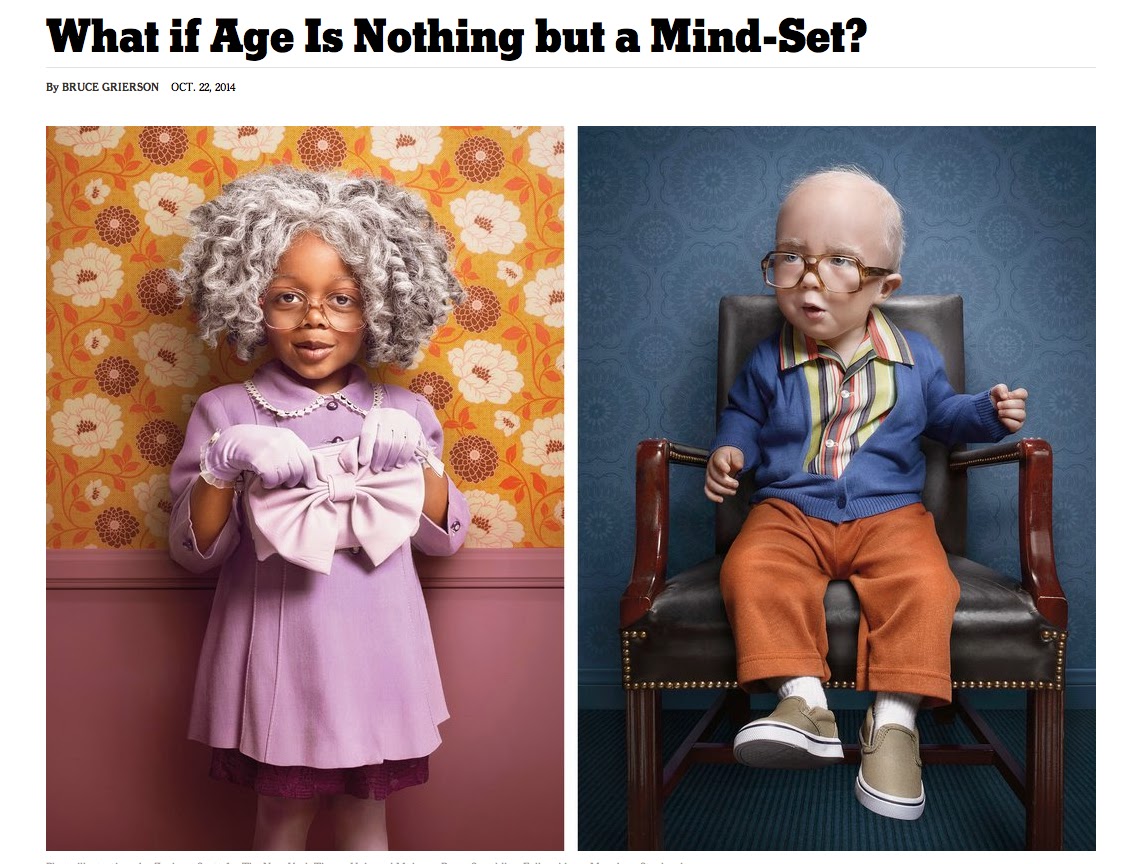
Ellen Langer's Work


One day in the fall of 1981, eight men in their 70s stepped out of a van in front of a converted monastery in New Hampshire. They shuffled forward, a few of them arthritically stooped, a couple with canes. Then they passed through the door and entered a time warp. Perry Como crooned on a vintage radio. Ed Sullivan welcomed guests on a black-and-white TV. Everything inside — including the books on the shelves and the magazines lying around — were designed to conjure 1959. This was to be the men’s home for five days as they participated in a radical experiment, cooked up by a young psychologist named Ellen Langer.
For the rest of the article please visit:
http://www.nytimes.com/2014/10/26/magazine/what-if-age-is-nothing-but-a-mind-set.html?ref=magazine&_r=1
This work bears a strong relationship to Cinemorphics. I discuss it in Method Aging and the Infinite game. 
http://cinemorphics.blogspot.com/2011/02/method-aging-and-infinite-game.html

Wednesday, October 15, 2014

Thomas Nagel: Thoughts Are Real


The philosopher Thomas Nagel’s new book, “Mind and Cosmos: Why the Materialist Neo-Darwinian Conception of Nature Is Almost Certainly False,” restores the primal force of a great old philosophical word, “metaphysics.” He starts with a boldly discerning look at that strange creature, mankind, and comes to some remarkable speculations about who we are and what our place is in the universe. Incidentally (and seemingly unintentionally) he illuminates, along the way, some significant aspects of the cinema, and of art overall.
To read the entire article, please click HERE.

Wednesday, October 08, 2014